- Guides Hub
Avoiding Private Sale Scams
Common scams to look out for when buying or selling a car privately and some practical ways to reduce the risk.
Most private vehicle sales are genuine.
But when something does go wrong, scams often rely on the same things: anonymity, pressure, misleading payment information or one side being asked to do something outside the normal course of the sale.
Knowing what those situations look like makes them much easier to spot.
This guide covers some of the scams and tactics worth knowing about when buying or selling a car, motorbike or motorhome privately.
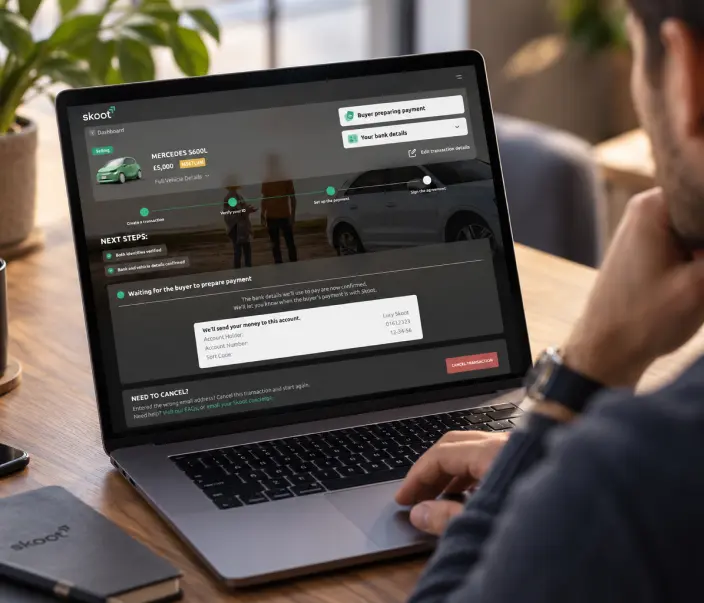
How Skoot Helps Protect Your Purchase
Find answers to the most common questions about how Skoot keeps your car purchase secure, simple, and stress-free.
1. Paying a holding deposit for a vehicle that doesn’t exist
A fraudster can copy photographs and details from a genuine advert, advertise a vehicle they do not own and ask interested buyers to pay a deposit to “secure” it.
There is often a reason why the vehicle cannot be viewed immediately, together with pressure to act quickly because another buyer is supposedly interested.
Once the deposit is paid, the supposed seller disappears or asks for further money.
What to watch for
Be cautious about paying money simply to secure a vehicle you have not seen, particularly where you cannot properly establish who the seller is or whether the vehicle exists.
How Skoot helps here
Skoot is designed so buyers and sellers do not rely on a separate holding deposit to show commitment.
Instead, the buyer prepares funds in their Skoot wallet before handover. That gives the seller a much clearer sign that the buyer is committed to the transaction, without the buyer having to send a separate deposit directly to someone they may not yet know well.
This avoids one of the main risks of a holding-deposit scam: sending money directly to a supposed seller before the wider transaction has been properly established.
There is also an added identity benefit. Both parties know they will need to verify their identity and address as part of the transaction, which can make Skoot a less attractive environment for someone relying on anonymity or false details.
2. Fake bank transfers, screenshots and banking apps
This scam usually becomes dangerous at handover.
The buyer has inspected the vehicle, both sides are ready to complete the sale and the seller is waiting for payment before handing over the keys.
The buyer then shows what appears to be convincing proof that the money has been sent. That could be a screenshot, a transfer confirmation or even a realistic-looking banking app showing the payment as complete.
The pressure comes from the moment itself. The buyer is standing there, the paperwork may be ready and the seller may feel that the only thing left to do is release the vehicle.
But what appears on the buyer’s screen is not proof that the seller has received the money.
What to watch for
If you are selling privately, do not hand over the vehicle because the buyer shows you a screenshot, confirmation screen or banking app.
Check your own bank account.
The payment should be visible in your account and available to you. If your bank distinguishes between pending and completed or cleared payments, make sure the payment is shown as completed or cleared before releasing the vehicle.
If the money is not there, the sale is not ready to complete.
How Skoot helps here
With Skoot, the seller does not have to decide whether a buyer’s screenshot, banking app or payment confirmation is genuine at handover.
The buyer transfers payment to Skoot before collection day, and Skoot confirms to the seller once the money is with us.
That means the payment position is established before the vehicle is released, rather than being decided in a pressured moment based on what the buyer can show on their phone.
3. The overpayment and refund scam
A supposed buyer appears to pay more than the agreed price and then asks the seller to return the difference.
They may say it was a simple mistake, or claim that the extra money is intended for a transporter, delivery company or another third party.
The danger is that the seller sends a genuine payment back before the original payment has proved genuine. If that original payment then disappears, is cancelled, proves fraudulent or never properly clears, the seller is left out of pocket for the money they sent back.
What to watch for
An unexpected overpayment should be treated as a warning sign.
Do not send the difference to another account or payment method simply because the buyer says they have paid too much.
Be particularly cautious if the buyer wants the excess sent to somebody else, such as a transporter or delivery company.
How Skoot helps here
With Skoot, the transaction is created around the specific vehicle and the agreed sale price.
Skoot sends only the agreed vehicle price, less the seller’s Skoot fee, to the seller. The buyer’s fee is handled within Skoot, and any extra balance is returned to the buyer.
That means there is no chance of the seller receiving an overpayment through Skoot and then being asked to refund the difference to another account.
4. Intercepted or changed bank details
This scam can happen even when both the buyer and seller are genuine.
A third-party fraudster gains access to, or convincingly impersonates, an email, text or marketplace message thread between them. They then send replacement bank details and make it look as though those details have come from the seller.
The buyer believes they are paying the seller and sends a genuine bank transfer — but the money actually goes to the fraudster.
That creates a problem for both sides. The buyer has sent the money, but the seller has never received it.
What to watch for
Be particularly cautious if bank details change during the sale, especially if the change arrives by email, text or marketplace messaging.
Do not assume a message is genuine simply because it appears within an existing conversation.
If you are paying a seller directly and receive new or changed bank details, verify them with the seller using a separate trusted method before sending the money.
How Skoot helps here
With Skoot, the buyer is never given the seller’s bank details.
The seller enters their payout details directly within Skoot, and those details are checked against the identity they have verified as part of the transaction.
The buyer then transfers payment to Skoot rather than to a bank account supplied by the seller in an email, text or marketplace message.
That removes the payment instruction a third-party fraudster would normally try to intercept or replace. There is no seller account number being passed between buyer and seller for somebody to substitute with their own.
For the buyer, that reduces the risk of sending the agreed payment to a fraudster because payment instructions have been changed.
For the seller, it reduces the risk of the buyer genuinely paying the wrong account and arriving at handover believing payment has already been made.
5. A seller or vehicle that isn’t what it appears to be
Sometimes the vehicle is real, but the person selling it, the paperwork or the vehicle itself does not match the story being presented.
That could be a trader posing as a private seller, someone trying to sell a vehicle they are not entitled to sell, or a vehicle or V5C that has been altered or falsely presented.
What to watch for
If someone is selling the vehicle as a private seller, check that their details make sense against the registered keeper information on the V5C.
Also check that the registration, VIN and other vehicle details match both the vehicle in front of you and the paperwork.
If something does not line up, ask why before going any further.
How Skoot helps here
Skoot gives the buyer several pieces of information they can compare.
The seller verifies their identity and address, so the buyer can compare those verified details with the registered keeper information on the V5C.
Skoot also retrieves the vehicle details held by the DVLA using the registration number. The buyer can compare those details with both the V5C and the vehicle they are looking at.
That creates a useful three-way check between the seller, the paperwork and the vehicle itself.
It does not prove legal ownership or guarantee that a vehicle has not been tampered with, but it makes inconsistencies harder to hide and gives the buyer more than one source of information to rely on.
6. Tampering during a viewing
Not every scam is about payment.
There have also been cases where people posing as buyers distract the seller during a viewing and interfere with the vehicle — for example under the bonnet — before claiming they have found a serious fault and using it to push the price down.
The vehicle may have been perfectly fine before they arrived.
What to watch for
Be wary if someone seems unusually keen to split your attention, asks you to move away from the vehicle, or suddenly claims to have found a major fault that was not there before.
If something feels wrong, you do not have to continue with the sale.
How Skoot helps here
Skoot cannot prevent someone interfering with a vehicle during a viewing.
But starting a transaction does not commit you to completing it. If something does not feel right, you can stop and cancel before the sale is completed.
7. Payment from a compromised account
A seller can receive what looks like a perfectly normal bank transfer, only for problems to emerge later because the money came from an account that had been stolen, compromised or used fraudulently.
That can leave the seller caught up in an issue they had no part in creating.
What to watch for
This is difficult for a private seller to identify from a direct bank transfer alone.
Seeing money arrive does not tell you whether the account it came from is legitimate.
How Skoot helps here
With Skoot, the seller does not receive the sale payment directly from the buyer’s bank account.
The buyer transfers the agreed amount to Skoot before handover. Once those funds are with Skoot, cleared and ready, Skoot sends the payment to the seller when the transaction completes.
That means the seller does not receive the sale proceeds from an unknown or potentially compromised buyer account.
8. Fake escrow or protected-payment websites
And yes, we can see the irony here.
We are warning you about unfamiliar payment services — and at the same time asking you to trust Skoot.
So don’t just take our word for it.
Fake escrow and payment websites can look convincing. They may copy a genuine business, create professional-looking emails or send you a link that appears completely legitimate.
The safest approach is to check the service for yourself rather than relying on the person at the other end of the sale to tell you it is genuine.
What to watch for
Be cautious if someone sends you a payment or escrow link and pressures you to use it quickly.
If anything looks unusual, check who is actually behind the service before sending money.
How to check Skoot is really Skoot
This one is different. We’re asking you to check us.
Skoot Payment Services Ltd is a registered UK company, company number 16126012, with its registered office at 15 Stratton Street, London, W1J 8LQ. You can check those details independently at Companies House.
You’ve already found our website — that’s a good start. Check that the address in your browser is skootpay.co.uk. If you want to speak to us, use the contact details or WhatsApp link on this site rather than anything supplied to you in a message by somebody else.
There are real people behind Skoot too. You can speak to the team directly, and we regularly meet buyers, sellers and car enthusiasts in person at established UK motoring events.
And if you want to look behind the payment side of the service, you can check Griffin independently too. Griffin provides the UK banking infrastructure behind Skoot, with eligible deposits protected by the Financial Services Compensation Scheme up to the applicable limit.
We’re asking you to trust Skoot with an important part of your sale, so we think you should check who we are first.
Go check us out.
Image / Design Note
Place a genuine photograph of the Skoot team at an established UK motoring event alongside this section. The image should visibly show the team/Skoot presence and event context rather than being a generic event photograph.
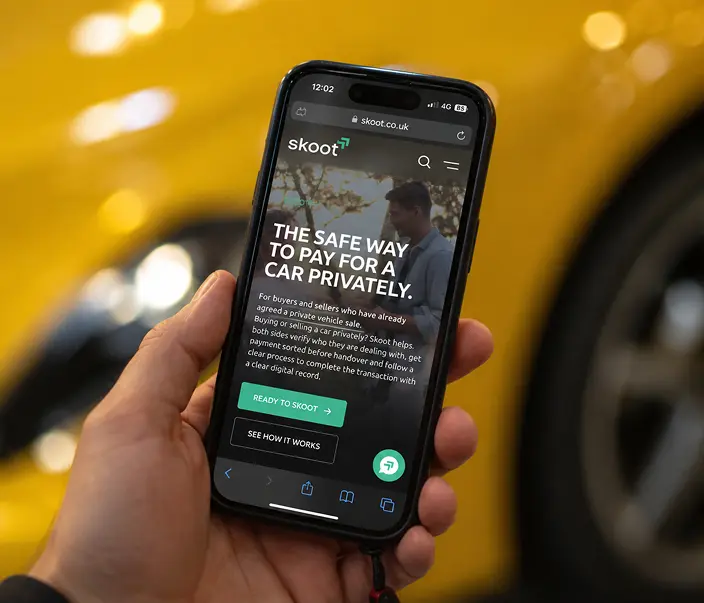
- A common theme
Scams often rely on pressure
Many scams rely on pressure — changed bank details, urgent deposits or payments that have supposedly been sent.
Skoot reduces that pressure by giving both sides a clear process. You know who you are dealing with, the agreed vehicle and price, when payment is with Skoot and when the sale is complete.
Payment, paperwork and handover happen in the right order, and if something does not feel right, the transaction can be cancelled before completion. Any money held with Skoot is then automatically refunded to the buyer.
This gives both sides a clear way to stop without being pressured into the next step.
How Skoot changes the transaction
Skoot cannot prevent every type of fraud or replace the checks you would normally make when buying or selling a vehicle privately.
What it can do is remove some of the situations that scams commonly exploit.
Both people verify who they are. The transaction is tied to a specific vehicle and an agreed sale price. The buyer gets payment sorted before handover. Seller bank details stay private. Skoot confirms when the money is with us. The paperwork and completion are recorded. And either side can stop before the transaction completes if something does not feel right.
That gives buyers and sellers a clearer, safer way to complete the sale than relying on messages, screenshots and a bank transfer arranged at the point of handover.